
As a young Pan Africanist, Yoweri Kaguta Museveni was only interested in joining the University of Dar es Salaam with an aim of participating in politics and liberation, to his disappointment, he found that many students were only focusing on careerism.
Determined to make a meaningful contribution, Museveni and other patriotic students formed a Pan Africanist students organisation called University Students African Revolutionary Front (USARF)which connected different students’ different countries across Africa.
They carried out political debates and at times invited lecturers to participate in their intellectual forums. Through these engagements, USARF established links with the liberation movements like The Revolutionary Front of Mozambique (FRELIMO), African National Congress (ANC), Pan Africanist Congress (PAC) of South Africa, South West Africa People’s Organization (SWAPO) of Namibia among others. he continued to participate in liberation movements.
In December 1968, Museveni, alongside other brave youths, toured to Mozambique to engage in FRELIMO discussions and liberational activities. On returning to Tanzania, other revolutionary members were eager to listen to what they experienced during their tour, they had a press conference to the media.
Julius Nyerere invited them to his home in Msasani to also have a highlight about their revolutionary tour to Mozambique which positively changed the Tanzanian government officials’ attitude on FRELIMO. Due to his passion for liberational movements, Museveni was also invited visit to North Korea to attend a journalist conference against imperialism in Pungnyang, he only attended on an account of being promised military training, in the due process, the trainee brought a pistol that was gifted to him by Fidel Castro as symbol of his revolutionary commitment. Upon completing his three-year university course, him and his colleagues including Eriya Kategaya, John Kawanga and Wapakhabulo returned to Uganda.
Back in Uganda, he was initially appointed to the foreign services; however, he was recommended to join the Office of the President where he worked in the research section, in this department, he analyzed newspapers and magazines from around the world, producing research and reports that informed government decision-making later on, Museveni and Ruhakana Rugunda began mobilizing politically for the Uganda People’s Congress (UPC) elections scheduled for April 1971.
Everything changed in January 1971, when Idi Amin staged a military coup while Obote was attending the Commonwealth Heads of Government Meeting in Singapore. The coup was sudden and violent, marked by mass killings and explosions in Kampala.
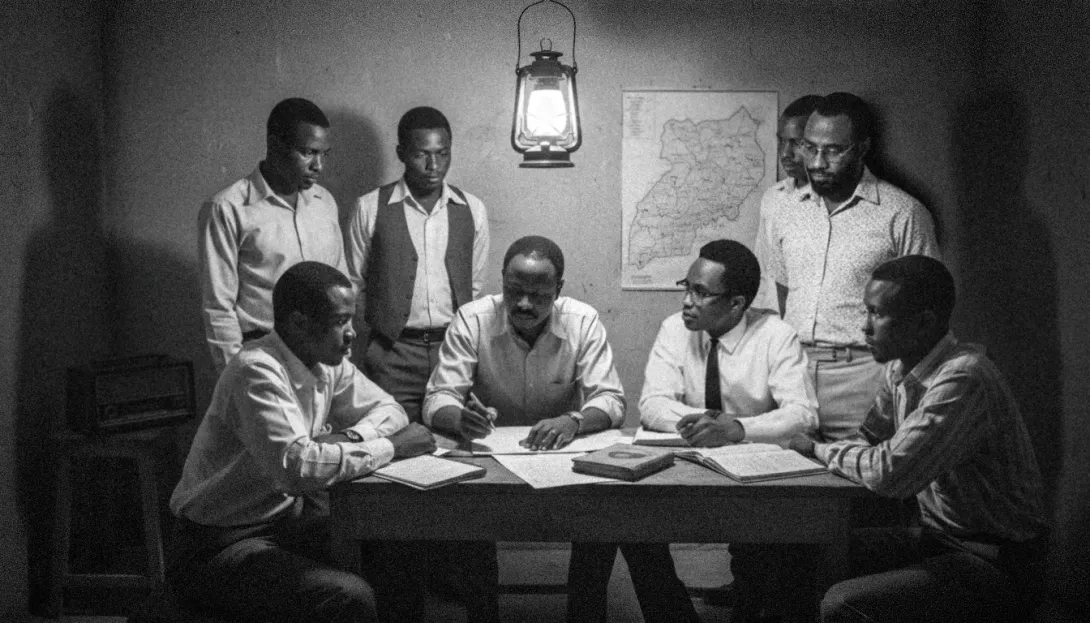
Amidist this chaos, Museveni and other young revolutionaries including Eriya Kategaya, Ruhakana Rugunda, and Mwesigwa gathered at Kanyomoozi’s house in Bugoloobi. They opposed Amin’s takeover and planned politics grounded in patriotism, Pan-Africanism, and anti-imperialism, rather than careerism. They resolved to resist, aiming to restructure Uganda’s politics, terminate indiscipline, and eliminate sectarian and colonial influences.
Museveni travelled to Mbarara and had a conversation with some Ankole political leaders who offered to help him to travel to Kayaaga, Karagwa district where they continued to Dar es Salaam. Shortly thereafter, they met Obote in exile reporting on the unfolding situation in Uganda.
Revolutionary activities intensified, laying the groundwork for the organized resistance that would later evolve into Front for National Salvation (FRONASA) which was against Idi amin’s regime. The Uganda Patriotic Movement (UPM) was formed in 1980 by Yoweri Museveni, Wogute, Jeremiah Opira and Bidandi SSali in preparation of Uganda’s post-Amin elections where Museveni contested as the presidential candidate in the 1980 general elections. After the elections were widely seen as fraudulent, Museveni launched a bush war that eventually brought him to power in 1986. Though brief, UPM marked his first step into national politics. and eventually the National Resistance Army (NRA).